


Some people, often unknowingly, are affected by the rocking movements of the boat, causing nausea and discomfort that spoil a wonderful experience at sea. If you think you might suffer from this issue, consult your doctor about taking seasickness tablets.
 Attrezzatura fornita da noi

Upon arriving at the diving center, you'll meet the staff and your instructor who will guide you through your unforgettable snorkeling experience among the Roman ruins. If you wish, we can provide you with the equipment and a wetsuit. The dive lasts 45-50 minutes and will allow you to admire various archaeological sites.

Under the sea, near Punta Epitaffio, in area A of the park, lies the Nymphaeum of Emperor Claudius, submerged at a depth of about 5 meters. It features a rectangular structure with a semicircular apse at the back and four niches on each long side. This construction, clearly visible below the surface, is made even more captivating by the reconstructions of the statues that once adorned the niches. The underwater route continues along a stretch of the Herculaneum road, the ancient access route to Portus Julius. Depth: 5 meters.

The ancient port of Baia appeared as a defined basin (known as Lacus Baianus) with an entrance channel still discernible today, alongside the remains of ancient shops and thermal complexes. Within this urban context, there are also the remains of a notable villa featuring a "prothyron" entrance, characterized by a portico with two long masonry benches. Depth: 5 meters.

This thermal complex, possibly a private residence, overlooked the ancient port of Baia, known as Lacus Baianus. The site was recently discovered, restored, and opened to the public in the summer of 2020. It's remarkable to observe the remains of various polychrome mosaics and marble floors, with interesting layers of overlapping mosaics. In addition to the outlines of several rooms and thermal baths, three semi-circular rooms can be seen, which once had large windows facing Lacus Baianus. Depth: 4 meters.

This important commercial port has been revealed through aerial photographs taken by diver R. Bucher, which highlighted the topography of the vast port complex, covering an area of about ten hectares. During dives, numerous remains of floors, columns, and marble fragments can be observed. A unique feature of the site is the presence of interesting mosaics. Depth: 3 meters.

This route winds through the area adjacent to the entrance of the ancient commercial port canal. Its name comes from the abundant remains of columns and a long colonnade, made of both marble and stucco. Several warehouse structures, which once supported port activities, can be admired. The current structures are the result of the overlapping of multiple buildings that occurred over at least 400 years. Further research has uncovered various floors, including an important wave-pattern mosaic and another in two colors, which completely cover the floors of the surrounding rooms. Depth: 3 meters.
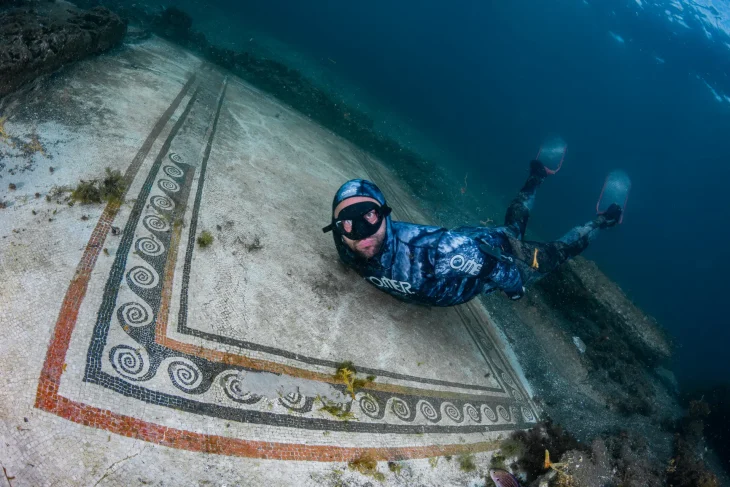
The single snorkeling immersion from Baia lasts about 3 hours. The experience concludes with the return to the diving center.
Attrezzatura fornita da noi 


The highlight of our vacation in Naples!
Excellent communication from the start with Ornella, easy to book and ask questions in advance. My husband, three teenage daughters, and I booked a dive and were very impressed by the organization, the quality of the equipment, and the entire diving experience. We are five complete beginners and were very well taken care of by a professional, enthusiastic, and fun team of eight divers. They were very patient and did everything possible to ensure we got the most out of our trip. Take the train from Naples to Fusaro, it takes 40 minutes and costs just a few euros each. Great beach, warm water, and a small harbor, and the pizzas next door are a must. I highly recommend using Subaia, a wonderful experience—thank you Penelope, George, and the team.